Search engines are rapidly evolving. First, Bing introduced its AI features with Bing Copilot, and now Google is rolling out AI Overviews and an AI mode to the Bangladeshi search results pages (SERPs). As large language models (LLMs) become more reliable and commonplace, SEO professionals need to adapt.
This shift is particularly crucial in Bangladesh, which has emerged as a significant hub for SEO freelancing over the past decade, with an unofficial study estimating the community at nearly 200,000 members.
As a pioneer in Generative AI-focused SEO in Bangladesh, I have recognized this need for adaptation. For quite some time, I have been teaching Answer Engine Optimization and Generative Engine Optimization on one of the country’s most prominent eLearning platforms.
My work directly addresses this new era of search, equipping the large and growing local SEO community with the skills they need to stay relevant and competitive.
Why do We Need to Adapt?
The most common question that I have been asked when I talk at public seminars or webinars, here is my answer –
How we use seach engine is changes – the old search results page was a list of 10 blue links, and the entire goal of SEO was to get a website to the top. Now the situation is changed we no longer require to click a link to get the answer. We can do our research directly in an LLM and even select the most suitable candidate from multiple AI-generated responses. So, we need to be there…
However, I strongly disagree with “SEO is dead” quote. It simply evolving. Meaning we will do the same thing but in different approch.
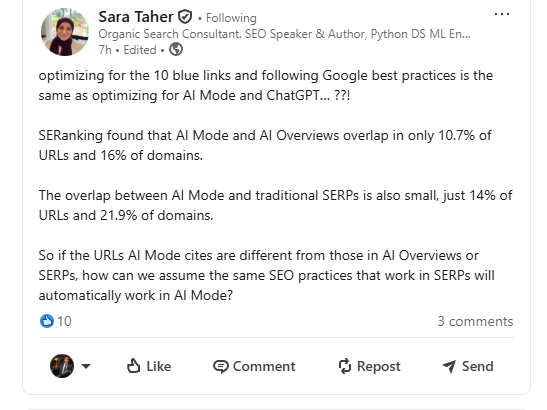
As this post by Sara taher on GEO vs SEO, explains a it clearly..
So we can say there is a very low overlap between the URLs cited in AI Mode, AI Overviews, and traditional search results (SERPs). For example, SERenking Research shows AI Mode and AI Overviews share only about 10.7% of URLs, and AI Mode and traditional SERPs share only 14% of URLs.
This suggests that the content and websites that rank well in traditional search may not be the same ones that AI models use as sources.
Therefore, a new set of SEO strategies may be needed to optimize for AI-driven search environments.
What is Generative Engine Optimization (GEO)?
Generative Engine Optimization (GEO) is the process of adapting a website’s content to improve its visibility and presence in AI-driven search environments. It aims to get a website’s content cited, quoted, or included in the synthesized answers provided by Large Language Models (LLMs) and AI search features like Google’s AI Overviews, Bing Copilot, and ChatGPT.
Key Strategies for Being Relevant in AI-First SERP
1. Adapt for AI longer queries (22~ words) than search (4~)
The rise of AI-driven search has significantly altered how users pose questions. They are no longer typing short, choppy keywords; they are requesting complex, conversational questions that average around 22 words. To adapt your content strategy, you must:
AI models favor content that provides a thorough, well-rounded answer in one place. Ensure your articles cover a topic from all angles, answering not just the primary question but also the follow-up questions that a user might have. This makes your content a complete source that an AI can confidently cite.
Don’t just target a single keyword. Instead, think about the full questions your audience might ask. Use tools like Google’s “People Also Ask” feature, forums like Reddit, and even AI chatbots to find these longer, more natural-language queries.
Focus on the user’s underlying intent behind the query. A user searching for “best cappuccino maker under $200” isn’t just looking for a product; they are looking to solve a problem. Your content should provide a direct answer, comparing different models and helping them make a decision.
2. Create Original, Expert, and Up-to-Date Content
In both SEO and GEO, content quality is the king. However, the signals of quality are interpreted with a higher degree of scrutiny by AI. For AI models, the “E-E-A-T” (Experience, Expertise, Authoritativeness, and Trustworthiness) framework is not just a ranking factor. It’s a core requirement for a source to be considered credible enough to be included in a synthesized answer.
So, in this case, the most on-page SEO practices we have been performing remain the same; however, there are some new ones too.
Demonstrate Real-World Experience.
Prioritize Freshness.
Write in-depth articles for users.
Build Authority Through Substance.
Optimize for Multimodal Content [NEW].
Optimize for Query fan-out queries.
3. Ensure Technical Health (Crawlability and Page Experience)
The most important factor for ranking on search engines is ensuring your content is the primary source selected during the retrieval process. And for appearing in LLM citations selected as the primary source during the retrieval phase of an AI’s response.
So the core remains same, if search and LLM bots do not find the source (website), they cannot validate your expertise or present your brand as the solution.
However,”finding” the source is no longer just about indexing a URL; it is about providing a frictionless path for bots to ingest your data.
While Googlebot has become proficient at rendering JavaScript, the reality for AI is different. Recent data shows that nearly 70% of AI-specific crawlers (such as GPTBot and ClaudeBot) still struggle to execute complex JavaScript. Source: Can LLMs Read Your SPA?
To ensure this accessibility, my advice is to prioritize three technical areas:
You must explicitly permit AI agents like GPTBot, OAI-SearchBot, and Claude-Bot in your robots.txt file.
To be “retrievable,” your core content should be present in the initial server response. Meaning its advisable to priorite Server-Side Rendering (SSR) over Client-Side Rendering (CSR).
Optimize server response time or Time to First Byte (TTFB), because AI systems often operate under strict latency budgets when generating answers for users.
4. Direct Citation Readiness
Industry experts are divided on “content chunking,” leaving many SEOs confused. To understand its true value, we must look past the hype and focus on how it facilitates retrieval-augmented generation.
However, the plot thickens when Google weighs in. Danny Sullivan recently warned against deconstructing content into ‘bite-sized chunks’ just to please LLMs, arguing that chasing AI-specific hacks is a losing game.
In my own practice, my experience aligns perfectly with the Search Engine Land guide on content chunking. Your goal shouldn’t to ‘break’ your content for a bot, but to structure it so clearly that it serves the human reader while remaining technically retrievable.
You can’t ignore Fraggles and passage ranking. You should not “chunking” for a bot; rather structure it for clarity.
As a long-time advocate of the inverted pyramid style, I can tell you that this classic framework is exactly what modern retrieval systems and your readers are looking for.
5. Predictive Intent Mapping
To stay relevant in an AI-first SERP, you must learn the mechanics of how generative engines actually “fetch” and “synthesize” data.
Google AI Overviews, Perplexity, Gemini) rarely search for a user’s prompt as-is. Instead, they use a technique called Query Fan-out (technically known in RAG).
The system breaks a complex user prompt into 4–6 parallel sub-queries.
Research shows that pages ranking for both the primary query and these “fan-out” sub-queries are 161% more likely to be cited in an AI Overview. (almcorp).
As we discussed, Google’s Danny Sullivan warns against “chopping” content, but technical reality dictates that organization is everything.
Use Deep-Link Fragment Anchoring if possible.
6. Reputation Ecosystem Management
Share
Facebook
Twitter
LinkedIn
Reddit
Email
About the author
S M Lutfor Rahman
I am S M Lutfor Rahman, a seasoned SEO strategist and the founder of LutforPRO. With over 11 years of experience in digital marketing, I have successfully managed 500+ projects across 80 countries.
LutforPRO provides SEO and Digital Marketing services, consultancy & training based in Dhaka, BD. Trusted by 500+ successful businesses across 80+ countries worldwide.